

Despite public health guidelines that recognise the many benefits of regular physical activity, only 1 out of 5 adolescents meet international physical activity recommendations, which include aerobic and muscle-strengthening activities.
Along with declining measures of cardiorespiratory fitness worrying trends indicate a steady decline in muscular fitness (i.e., muscular strength, muscular endurance, and muscular power) in youth worldwide. Because a certain amount of strength is needed to move and play skillfully, weaker youth are less likely to accumulate at least 60 minutes of physical activity each day.
Without early exposure to appropriate strength-building activities, current trends in physical activity will likely continue as weaker youth fail to gain confidence and competence in their physical abilities.
Ready, Steady, Go is an integrative framework for children that develops muscular strength, improves physical literacy, and protects against injuries. Preparing children for a lifetime of physical activity.
Ready, Steady, Go helps improve and develop four key areas.
Engagement, activation, movement, and protection.
Fun and enjoyable activities improves engagement, confidence, competence, and motivation to take part. The progressive nature of the programme improves muscle activation and joint mobilisation. Over time functional power and strength increases which improves movement skills and physical literacy. And finally it develops the muscles, tendons, and ligaments ability to endure physical demands and forces placed on them during sports or physical activities, reducing the risk of exercise related injury.
Developing these four key areas contributes to the many health benefits of regular physical activity. Building a foundation for children to engage in exercise and sport activities as they get older. Improving fundamental movement skills that are the building blocks for a lifetime of physical activity. Reducing the risk of activity-related injuries, and improving mental well-being.
The Ready Steady Go Framework
Allow up to 15 minutes at the start of each session to undertake Ready, Steady, Go activities. Each 15 minutes should be split into 3 parts of 5 minutes, with a particular focus in each part.
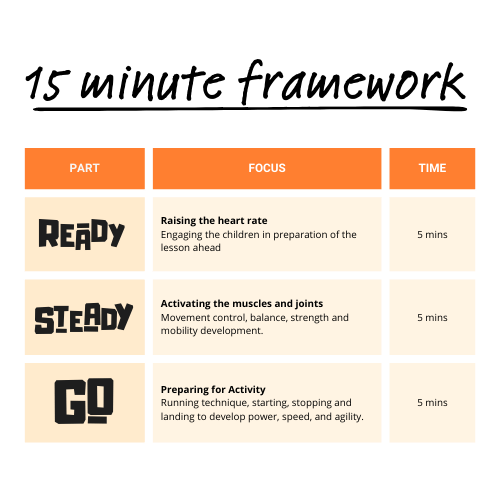
Part one get your children READY, focus on raising the heart rate and engaging the children in preparation of the session ahead.
Part two get them STEADY, focus turns to activating the muscles and joints by introducing strength, balance, and mobility exercises.
Part 3 let them GO, focus is now on preparing them for the activity ahead, speed, power, and agility activities.
How to deliver Ready Steady Go
In order for the Ready, Steady Go activities and exercises to have the most benefit focus should be on quality over quantity. Even with young children, you should look to correct technique and body positions to develop appropriate control and balance.
Ready, Steady, Go is about introducing children to key movement patterns, so they start to learn and understand how to control their bodies through balance and coordination.
Developing fundamental movement skills in children at a young age can have a beneficial influence on their relationship with physical activity as they get older.
You play a crucial role in this process by monitoring your children, and encouraging them to focus on the quality of technique, and effectively communicating the key coaching points that will improve performance.
Top Tips
- Take time to become familiar with the framework and plan the activities and exercises before starting each session.
- Use children to demonstrate certain exercises and to talk through the key coaching points for the whole group to see.
- Get creative! Think about how you can make it fun and engaging. To develop skills the repetition of exercises and body positions is important but they can be delivered in many different ways.
- Focus on only one or two key coaching points at a time
- Consider the introduction of a ball or other suitable equipment as a way to challenge pupils.
- Watch pupils carefully to identify and correct any incorrect technique. If needed, provide feedback.
- Ask pupils questions to help develop their understanding of the exercises and why they are used.
- Share your ideas. Talk to other coaches to share ideas about Ready, Steady, Go activities that work well and what the pupils enjoy.
To learn more about Ready, Steady, Go activities and how to best prepare children for a lifetime of physical activity check out our online course ‘Healthy Active Kids’
 Healthy Active