

Whenever possible, it’s recommended to be active every day.
150 minutes of moderate intensity, or 75minutes of vigorous intensity physical activity is recommended every week, with activities that develop or maintain strength being included at least twice a week.
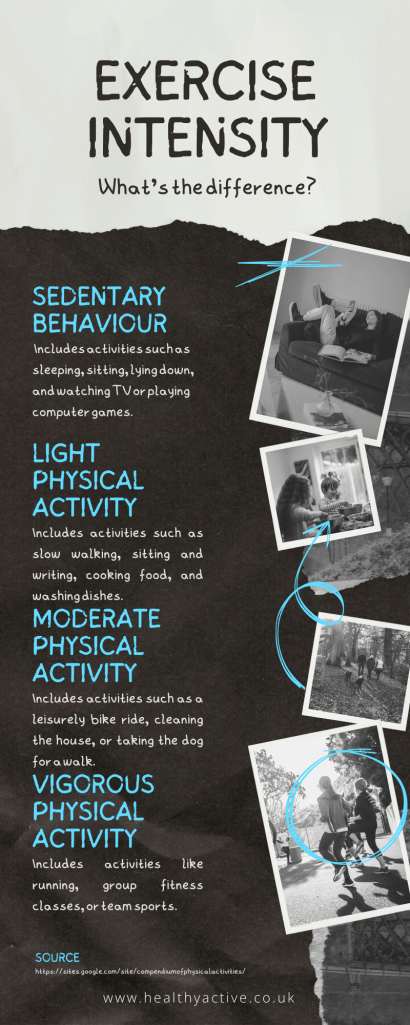
But how do we know what type of activities benefit us the most, and how can we identify what activities are of a moderate or vigorous intensity?
What is physical activity?
Physical activity is any movement of the body produced by the muscles that requires you to use energy. It takes many forms, occurs in many settings and has many purposes.
Health enhancing physical activity includes lots of different types of activities, and can be of low, moderate, or vigorous intensity – and importantly is relative to an individual’s fitness.
What could be light intensity for a young person who is very fit and active, could be moderate or vigorous intensity for an older adult or younger person who is inactive and unfit. Although physical activity of any intensity provides health benefits
activity at a greater intensity provides more benefit for the same amount of time.
Activities need to be of at least moderate-to-vigorous intensity to achieve the full breadth of health benefits.
Measuring exercise intensity
There are a number of ways that we can measure the intensity of an activity or exercise, from the number of calories burnt, or the amount of oxygen required to perform an exercise, to a persons heart rate when performing an exercise or activity. And this has become a lot easier and accessible to track more accurately over the past 10 years as, technology and wearable devices and applications have been developed to help us track/record our activity levels
Classifying exercise intensity
Over the past 20 years the most widely used method for classifying exercise intensity has been the Metabolic Equivalent System.
The amount of oxygen your body consumes is directly proportional to the energy you expend during physical activity.
All physical activities can be classified by intensity according to their oxygen requirements., but how can we tell the difference between light, moderate, or vigorous physical activity?
The sciency bit
At rest, your body uses approximately 3.5ml of oxygen per kilogram of body weight per minute. This resting metabolic rate is referred to as 1.0 metabolic equivalent unit (MET).
An activity that is rated as a 2.0-MET would require two times the resting metabolic rate, or 7ml of oxygen per kg of bodyweight per minute.
And an activity that is rated at 4.0 MET would require approximately 14ml of oxygen per kg of body weight per minute.
A Compendium of Physical Activities
was developed to compare intensity levels of different types of physical activities performed in every-day life.
It’s a comprehensive list of 605 different activities and assigns a unique code to the type, purpose, and importantly intensity of activities performed in daily life -ranging from inactivity to sports and exercise.
Everyday examples:
- Sitting and watching TV (1.3 METs)
- Putting the hoover around (3.3 METs)
- Digging the garden (5.0 METs)
- Playing with the family (5.8 METs)
It’s important to remember that this list was designed as a framework for guidance and that activity intensities are specific to an individual’s level of physical fitness.
 Healthy Active